|
|
 |
Presented by: |
 |
|
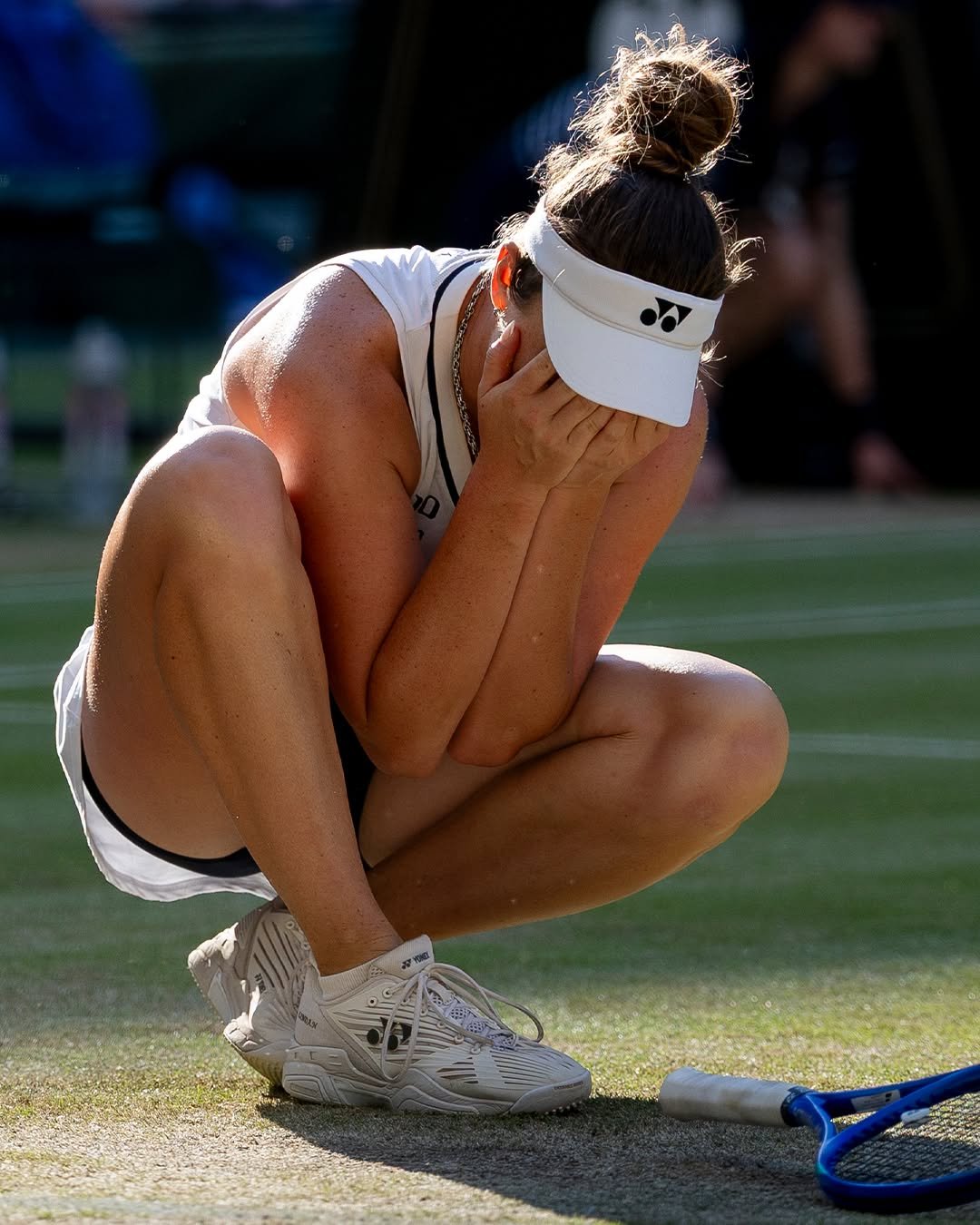
"There's one more person I would like to thank, which is my mum."
— Linda Noskova, after winning Wimbledon, her first Major, and dedicating it to her mother, who passed away two years ago. |
|
 |
|
Photo: Wimbledon |
Why the USWNT still gets $6 million from the U.S. men's World Cup exit ⚽
The men's World Cup is now down to the final four — literally right now! go watch the semifinal! — and shoutout to all the women working behind-the-scenes. We've especially loved Tobin Heath's technical analysis, as the first woman to serve on a FIFA men's technical committee.
Even after being eliminated in the round of 16, the U.S men will still take home $15 million from this World Cup. But thanks to a groundbreaking collective bargaining agreement, the U.S. men and women actually pool and split their prize money.
That means that after U.S. Soccer takes its 20%, the remaining $12 million will be split between the USWNT and USMNT. The money goes into an account through this World Cup cycle before being split up to individual players and programs. And both teams also committed, in the agreement, to funding development efforts.
Along with addressing the fact that FIFA wasn't paying equal prize money, the agreement should also work out for everyone involved:
-
The U.S. men have never advanced beyond the quarter-finals (in 2022) & have been eliminated in the round of 16 the last three World Cups
-
The U.S. women have won four World Cups 🥇 🥇 🥇 🥇
-
However, for their 2019 win, the women only took home $4 million 😡 — while the men's winners this year will take home $51 million
-
But, women's prize money increased for 2023 and FIFA has said they "hope" to equalize prize money for 2027 🤞
So the U.S. women could bring home another big payday for everyone next year!
Now, for the perennial debate: With the U.S. men's ugly loss to Belgium, the usual questions are being raised about what is wrong with soccer development in the U.S. and how the USMNT could live up to its potential. But, what if...
The question shouldn't be 'Why is the U.S. not good at soccer?'
The question should be 'Why are the U.S. women very very good at soccer and the U.S. men not as good?'
The answer to the second question has a lot to do with Title IX giving U.S. women a leg up on women's teams from other countries; it has to do some with the U.S. college system historically being the premier development system for female athletes (though this is changing some with the overhaul of the NCAA and with many of the European soccer leagues investing now in their women's arm); and it has to do a lot with soccer being one of the top professional sports opportunities for U.S. women, comparatively.
There are a lot more reasons, too! But if you ask the second question — the right question — then you'll get a more useful and illuminating answer.
📚 READ: Soccernomics: Why European Men and American Women Usually Win--And American Men Don't (Yet) |
It's time for Flavor Flav's SHE Weekend 👑
Now for the party 🎉
This Thursday through Sunday, Flavor Flav's SHE Weekend will take over Vegas to celebrate female athletes and Olympians. What started as a tweet, after the U.S. women's gold-medal-winning hockey team was treated poorly, has now turned into a massive celebration of women's sports. (SHE stands for Sports, Hospitality and Entertainment.)
What's happening
🎉 Public festivities kick-off on Thursday at 7 p.m. with a free concert in Toshiba Plaza
🎉 The parade then starts at 8 p.m. and goes by MGM through the Strip
🎉 Athletes will then receive a key to the city
🎉 And panels, speakers, performers and celebrations go on all through the weekend
See the full schedule here and follow along on Youtube with special coverage. And get the merch 😉
Tip of the week
This week, pro triathlete Danielle Lewis became the latest athlete to open up about dealing with Relative Energy Deficiency in Sport (REDs). Earlier this month, cyclist Chloe Dygert also came forward to say she'd been dealing with REDs.
REDs happens when the energy you're putting out (training + life + basic body functions) isn't matched by the energy you're bringing in (ie. fueling). Chronic underfueling of your energy needs can cause the body to short-circuit and result in: fatigue, illness, bone stress injuries, gut issues, brain fog, reduced strength and power, performance declines, and even hormonal dysfunction.
A growing number of athletes — including both of these women — are starting to recognize that this isn't always the result of deliberately restricting calories or disordered eating. Energy mismatch can happen simply from not fully meeting your body's needs!
LEARN MORE: "Why every endurance athlete needs to understand LEA and REDs" |
|
|
|
The highlight reel
- 🏃♀️Courtney Dauwalter has now won the high-altitude rugged Hardrock 100 in Colorado four times (!) and she set a new course record this year for the clockwise direction. (The route rotates directions each year.)
- 🏃♀️ Emily Venters won her first U.S. national title, in the 6K on the road.
- 🏃♀️ Agnes Ngetich won the 3,000m at the Monaco Diamond League meet in the third-fastest time ever (8:08.95). And Olympic triathlon champion Cassandre Beaugrand took to the track for 8th place and a French national record (8:32.86).
- France 🇫🇷 also took the mixed relay triathlon world title (and the first qualification spot for the L.A. Olympics).
- In the World Triathlon Para Series, Grace Norman is unstoppable. She took another win — and continued her five-year undefeated winning streak.
- Melisa Rollins 🚵♀️ is the new U.S. XCM (cross-country marathon mountain bike) national champion.
- 🚴♀️ Two-time mountain bike world champ, Kate Courtney, signed a two-year deal with road cycling team FDJ Suez with the goal of going after the road race at the L.A. Olympics.
- 🏌️♀️ Until two weeks ago, Haeran Ryu had never won an LPGA Major. Now, she's won two . She held off Brooke Henderson at the Evian Championship, who came from behind with an impressive run and a hole-in-one.
- Emma Hunt became the first woman to go under six seconds in speed climbing.
- Aliyah Tan won the U.S. national yo-yo championship. 🪀
- Australia 🇦🇺 took its seventh T20 cricket world title. (T20 is the shortened format of cricket designed to last about three hours.)
- 🏀 The WNBA All-Stars were named for the All-Star Game on July 25.
- ⚾ The Women's Pro Baseball League unveiled the four team names and logos ahead of the season starting on Aug. 1.
- 🤺 The World Fencing League says it attracted 1.8 million viewers to the broadcast of its first event, using blade tracking technology that allows viewers to see where the blades are going.
- ⚽ The NWSL released mid-season numbers showing games averaging 11,044 fans per match (a 10% increase on last year) and a 41% increase in Youtube views compared to the same period last year.
- Last week was also "rivalry week" in the NWSL — with teams meeting up against long-time rivals. Despite L.A.'s Angel City beating the San Diego Wave, the Wave remains on top in the overall standings.
- The International Olympic Committee announced the program for the 2030 Winter Olympics: synchronized figure skating is in, Nordic Combined is out.
- And it's two years today until the L.A. Olympics & Paralympics!
Your Feisty recommendations
🎧 What to listen to: "LIVE: A women's health and performance panel with Keely Henninger, Dr. Emily Kraus, Dr. Gauri Desai, and Dr. Alyssa Olenick"
📚 What to read: "How She Did It: Jenn Lichter's Record-Breaking Western States Win"
📺 What to watch: Row of Life — follows Angela Madsen, a former Marine and 3x Paralympian, on her attempt to solo row from L.A. to Hawaii
🫶 What we loved: The details in how the all-white outfits get approved for Wimbledon 👗
|
|
|
|
|
|
|
|
|
|
|