|
|
|
|
|
🎶 The Science Behind the Perfect Playlist
When I was training for Ironman, there were many times I found myself sitting on the stairs in my house, covered in sweat and salt and scattered dead gnats stuck in the sunscreen on my shoulders, staring at my Sauconys, desperately trying to muster the motivation to pull on those shoes and do my brick run (that’s a run designed to be done directly after a training ride, for the non-triathletes in the house). And the well was just bone dry.
In those moments, I would stick an earbud in my ear, pull out my phone and tap the little black arrow on my Ironman playlist. The first song was One Tree Hill by U2. And it never failed me. Those first few haunting guitar strains stirred something deep inside that said, “Okay, let’s do this.” Not in the let’s effing go! way that your typical hype music might (I’m a Nine Inch Nails or Missy Elliot girl for those moments), but in a slow emotional build way that met me exactly where I was—low and fatigued—and lifted my energy enough to get off the stairs, and helped me build momentum as I turned my legs over down the block. Atmospheric, rather than beat dominant, it encouraged me to dissociate from my discomfort and get carried away by the swaying rhythm.
I didn’t stay there, of course. Once in motion, I could launch into some Crystal Method or classic Lady Gaga to keep me humming along. All of this mirrors a new analysis from Chordify—an AI powered online music learning platform—which reports that the songs most likely to keep you rolling through longer workouts include three key components: optimal tempo (BPM, or beats per minute), emotional uplift (hello, U2), and rhythmic consistency.
The ideal beats per minute is activity dependent, but the platform reports that 120 to 170 bpm is most effective for keeping in motion without premature fatigue.
🎵 Evidence on “Optimal BPM” Ranges
Science backs this up. Meta-analyses and reviews find that tempo is a key determinant of motivational effects, with (unsurprisingly) faster tempo generally more effective for moderate-to-high intensity exercise. Research on cyclists and treadmill runners, for instance, has found that moderate tempo music—120 to 140 bpm—enhanced performance in those disciplines.
There are multiple factors at play here, but simply put, music gives you something to synchronize your effort with. One study found that synchronizing your workouts to music literally makes you more efficient—when a group of exercisers pedaled along to various music selections, they used 7% less oxygen for the same workload when they synched to their exertion to the beat than when they were out of sync. It also lifts your mood, and is pleasantly distracting when your legs are screaming in pain.
So with that, here are some recommended beats per minute ranges and playlists to play around with for your favorite activities.
🧘🏽♀️ Warm-up / Mobility
~90–110 BPM (calming, rhythmic)
-
Sunset Lover – Petit Biscuit (~91 BPM)
-
Electric Feel – MGMT (~103 BPM)
-
Slow Burn – Kacey Musgraves (~75 BPM)
-
Come Away With Me – Norah Jones (~81 BPM)
🏃♀️ Steady Cardio / Zone 2 (endurance runs, rides)
~120–140 BPM (aerobic efficiency + lower RPE)
-
Don’t Start Now – Dua Lipa (~124 BPM)
-
Shut Up and Dance – Walk the Moon (~128 BPM)
-
Hung Up – Madonna (~120 BPM)
-
Feel So Close – Calvin Harris (~128 BPM)
🚴♀️ Tempo / Threshold / Steady Climbs
~140–160 BPM (motivational, cadence-driving)
-
Can’t Hold Us – Macklemore & Ryan Lewis (~146 BPM)
-
Dog Days Are Over – Florence + The Machine (~150 BPM)
-
Mr. Brightside — The Killers (~148 BPM)
-
Shake It Off — Taylor Swift (~160 BPM)
🔥 HIIT / Sprints / Power Intervals
~160–180+ BPM (short efforts, high arousal)
-
Lose Yourself – Eminem (~171 BPM)
-
Blinding Lights – The Weeknd (~171 BPM)
-
Hey Ya – Outkast (~160 BPM)
-
Misery Business — by Paramore (~173 BPM)
🏋️♀️ Strength Training
Heavy lifts: 120–140 BPM | Circuits: 140–160 BPM
-
Seven Nation Army – The White Stripes (~124 BPM)
-
WTF (Where They From) – Missy Elliott, Pharrell Williams (~126 BPM)
-
Heads Will Roll — by Yeah Yeah Yeahs (~132 BPM)
-
Freaks – Timmy Trumpet (~128 BPM)
|
|
|
👀 What Caught My Eye
If you’ve ever felt kinda dumb after a marathon or similarly grueling endurance endeavor (🙋🏻♀️), you’re not alone—and a new study published in Medicine & Science in Sports & Exercise points to a scientific basis behind the post-event brain drain.
In the study, researchers examined cognitive function of trained female runners before and immediately after a marathon and found high-level thinking takes a hit. After the race, women were about 19% less accurate on demanding working-memory tasks—the kind of thinking you use to hold multiple pieces of information in your head, make decisions, and problem-solve. Interestingly, their reaction times actually got faster, suggesting a sort of speed-over-accuracy tradeoff: quicker decisions, but sloppier ones when the task was mentally hard. In short, simple thinking held up, but complex thinking suffered.
But some reports on this study “buried the lede” as they say in journalism—they covered what might be the main point much later in the story. That is: fueling mattered—a lot. Brain recordings showed the athletes’ brains were working significantly harder after the marathon, especially in women who took in less carbohydrates during the race and those at higher risk of low energy availability. In fact, markers of chronic underfueling (including menstrual disruption) were the strongest predictors of how much working memory declined.
The takeaway isn’t that marathons are “bad for your brain,” but that your brain is metabolically expensive, and when fuel runs low, cognition is one of the first systems to pay the price. Adequate fueling—both day-to-day and during long events—doesn’t just protect performance and recovery, but also helps preserve clear thinking, decision-making, and mental resilience when fatigue is highest.
|
|
|
|
|
|
🔥Badass Athlete of the Week Goes To…
When I say we’ve only just begun to scratch the surface of our performance potential as 40+ women, I mean it…and there may be no better evidence of that than what ultrarunner Ashley Paulson, 44, pulled off last week.
In a jaw dropping feat of endurance, Ashley won the Jackpot 100 by more than two hours with a time of 12 hours, 19 minutes, and 34 seconds—an average pace of 7:21 per mile. (Which I’m happy with for a 5K!) Her time was swift enough to smash the Women’s World Record time for 100 miles.
Phenomenal feat, Ashley! Thanks for the inspiration!
|
|
|
|
👉Want a chance to be featured? Click here to share your badass story |
|
|
|
Join me in Mallorca!
Life moves fast. Between work, family, training, and the constant pull to do more, it can feel like you’re always in motion and always the person responsible for taking care of everyone else (even planning the family vacation).
That’s why we joined forces with some of our favorite people to build this experience for feisty women like you — women who love a good challenge, beautiful places, great company, and a week that finally lets them slow the pace and just be.
Join us for Mallorca Road—a 6-day, women-only cycling trip from May 17–22, 2026, in partnership with The Cyclist’s Menu, set in the Balearic Island paradise of Mallorca, Spain.
Want to come ride beautiful roads and eat good food with Kathryn and I?
Learn more here. |
|
|
👩🏻💻 Hit Play Research Round Up
We spend a lot of time scouring the latest research for news you can use to stay strong and feisty forever. Here’s what’s making waves this week:
💊 Early hormone therapy use significantly reduced heart disease risk in most (but not all) women in a new long-term study. When researchers followed 2,427 postmenopausal women for 14 years, they found that, for most women, starting menopausal hormone therapy (HT) within 5 years of menopause was linked to a 28% lower risk of major cardiovascular events and a 38% lower risk of death from any cause. Among Chinese participants, however, HT was associated with a higher risk of cardiovascular events and a trend toward higher mortality, with this increased risk seen mainly in women with metabolic syndrome or high triglycerides. Overall, the findings support the idea that starting hormone therapy earlier can be heart-protective for many women. They also show we have more to learn about the roles of metabolic health and ethnicity.
💪 Lifting is good for your heart. A two-year randomized trial in women over 60 found that lifting weights 3 times per week not only built strength, but also improved heart health. Resistance training preserved healthy heart structure and relaxation between beats, while non-training women showed clear signs of age-related cardiac decline. Strength training reduced age-related heart wall thickening and left atrial enlargement, and improved metabolic health, muscle mass, and physical function. Bottom line: long-term strength training helps slow–and may even reverse–key aspects of cardiac aging in women.
🍠 Carb quality in your 40s and 50s matters, according to a long-running study of more than 47,000 women followed from midlife into older age. Women who ate more high-quality, whole-food carbohydrates like, whole grains, fruits, vegetables, legumes, and fiber, were more likely to age without major chronic disease or physical, cognitive, or mental health decline. Diets higher in refined carbs and added sugars were linked to poorer aging outcomes. Bottom line: not all carbs are equal. Choosing fiber-rich, minimally processed carbs in midlife may pay off for decades.
|
|
|
|
|
|
|
What's On My Mind...
The Olympics. I’ve always been pretty sappy about the Games—the hours, days, weeks, months, years, and often decades, of dedication on display. This year, with 47% of the field being female, they hit even harder. I’m grateful for the work and sacrifice of each and every one of those athletes. Thank you for showing us the best in all of us.
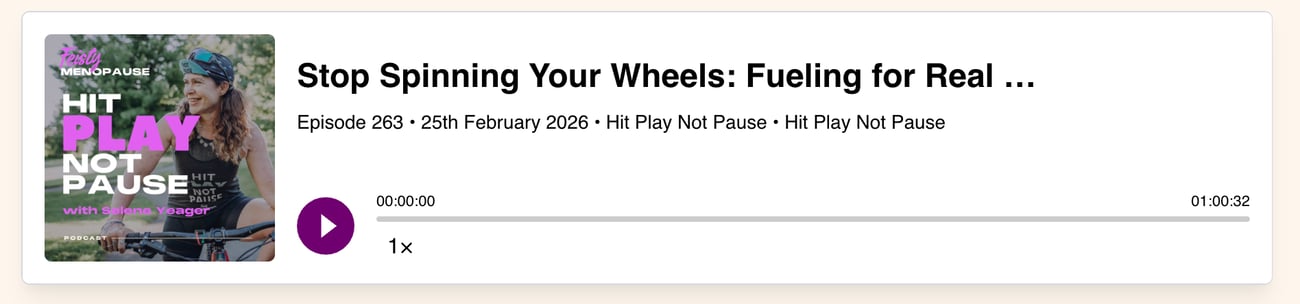
Listen to this week's episode of Hit Play Not Pause - Stop Spinning Your Wheels: Fueling for Real Midlife Gains
|
 |
|
|
|
|
|
|
|
Feisty 40+ is written by Selene Yeager. Edited by Maya Smith. Ads by Ella Hnatyshyn
Live Feisty Media Corporation, 2031 Store St #30, Victoria, British Columbia V8T 5L9, Canada
Update your email preferences or Unsubscribe |
|
|
|
|