|
|
|
|
⛹🏽♀️1 Minute of Vigorous Exercise Appears to be Worth a Whole Lot More Than We Thought
Whether it’s shooting hoops with your kids, dashing up the stairs for that thing you forgot, chasing your dog around the park, or sprinting for the town line sign on your bike, every minute of vigorous activity counts considerably more than we’ve traditionally thought.
In fact, according to a study published in Nature Communications that’s burning up the internet, 1 minute of vigorous physical activity (VPA) was associated with similar reductions in risk as approximately 4 to 9 minutes of moderate activity (MPA) and about 53 to 150+ minutes of light activity (LPA) for mortality and cardiometabolic disease. This challenges the long-standing assumption about how much more potent vigorous activity is per minute—namely, that 1 minute of vigorous exercise is worth about 2 minutes of moderate exercise, which underpins current exercise guidelines recommending 150–300 minutes of moderate or 75–150 minutes of vigorous activity per week.
It also reinforces that every minute really does count when it comes to your health. Even very brief, unstructured bursts of hard movement—what researchers often call VILPA (vigorous intermittent lifestyle physical activity)—count as vigorous activity and are strongly associated with lower mortality and cardiometabolic risk.
Minute by Minute
For the study, researchers analyzed device-measured activity in about 73,500 adults from the UK Biobank database and followed their health outcomes for about 8 years. For reference: “vigorous” was defined by high-intensity movement patterns detected by a machine-learning algorithm applied to raw wrist accelerometer data—not by METs, heart rate, or self-report—capturing real-world, often short, bursts of hard movement.
-
For all-cause mortality: 1 minute of vigorous activity was associated with similar reductions in risk as about 4 minutes of moderate or about 53 minutes of light activity.
-
For cardiovascular mortality: 1 minute of vigorous activity was associated with similar reductions in risk as about 8 minutes moderate or about 73 minutes of light activity.
-
For major adverse cardiovascular events: 1 minute of vigorous activity was associated with similar reductions in risk as about 5.4 minutes of moderate activity or about 86 minutes of light activity.
-
For cancer mortality: 1 minute of vigorous activity was associated with similar reductions in risk as about 3.5 minutes of moderate activity or 156 minutes of light activity.
-
For type 2 diabetes: 1 minute of vigorous activity was associated with similar reductions in risk as about 9 minutes of moderate activity or about 94 minutes of light activity.
Some have been suggesting that this study should drive changes in our exercise recommendations. Maybe? Because this study used wearables, it captured the kind of short, hard bursts we normally miss in research that asks people to recall their exercise bouts—like stairs, hills, and rushing around—which helps explain why vigorous activity looks so powerful per minute. I think if it filters into the official exercise guidelines, it should just be used to underscore the fact that every minute you’re moving with vigor really does help your health.
I also have nagging questions about healthy user bias in this one. To be clear, the researchers took strong steps to reduce it—including extensive adjustment, disease exclusions, and device-based measurement—but I’m not sure you can ever fully separate the effects of vigorous movement from underlying health and physical capacity that allows folks to move quickly and vigorously throughout the day.
Plus, we never want to dissuade folks from doing light physical activity, because reams of research shows there are benefits there, too. Volume of activity matters—a lot. In my mind, this is a great example of a high tide raising all boats. It’s why we recommend sprint intervals, hill repeats, heavy lifting, plyometrics, and all sorts of stuff that stresses the system to keep it strong. Doing those types of exercises also gives you the power and energy to dash across the airport to make your flight, hustle down the street with loaded shopping bags, and live in a vigorous way that is clearly very good for you. |
|
|
|
Join me in Mallorca!
Life moves fast. Between work, family, training, and the constant pull to do more, it can feel like you’re always in motion and always the person responsible for taking care of everyone else (even planning the family vacation).
That’s why we joined forces with some of our favorite people to build this experience for feisty women like you — women who love a good challenge, beautiful places, great company, and a week that finally lets them slow the pace and just be.
Join us for Mallorca Road — a 6-day, women-only cycling trip from May 17–22, 2026, in partnership with The Cyclist’s Menu, set in the Balearic Island paradise of Mallorca, Spain.
Want to come ride beautiful roads and eat good food with Kathryn and I?
Learn more here. |
|
|
👀 What Caught My Eye
Beginning this year, the National Health Service in England will be including menopause screening in routine health checks that are offered to adults ages 40 to 74 every five years. The checks were established to identify people at risk of conditions like dementia, diabetes, heart disease, kidney disease, and stroke. Now women will also be asked about menopause and menopause symptoms.
According to the NHS: “By making menopause a part of these health checks, we’re raising awareness of symptoms and giving women the confidence to seek help. Women reporting symptoms will be directed to services, information, and treatment options to provide relief.”
I’d love to see a similar standard of care implemented in the US and elsewhere.
|
|
|
|
|
|
🔥Badass Athlete of the Week Goes To…
⛷️ We have got to give it up again for Lindsey Vonn! Vonn, now 41, kicked off her Olympic season last month with an earth-scorching winning run at the World Cup downhill in St. Moritz. Her win was her 83rd career victory and made her the oldest winner–female or male–of a World Cup race ever. She finished nearly a second faster than the next contender.
This comeback is definitely one to watch. 🔥
|
|
|
|
👉Want a chance to be featured? Click here to share your badass story |
|
|
|
The Women's Performance Podcast is BACK! 💪
We’ve relaunched the Feisty Women’s Performance podcast, hosted
by Dr. Erin Ayala, to provide women with science-backed answers to their health and performance questions based on research actually designed for women.
Too often sports science is based on men and answers to even our most basic health and training questions come through a male lens.
This podcast aims to cut through that noise and get active women the insights they need, whether it’s how much protein you actually should be eating or how to manage sleep disruptions.
The Feisty Women’s Performance podcast is out now with new episode every Monday! Listen to the first episode here or watch on YouTube. |
|
|
👩🏻💻 Hit Play Research Round Up
We spend a lot of time scouring the latest research for news you can use to stay strong and feisty forever. Here’s what’s making waves this week:
🦴 Hormone therapy + structured exercise = best bone density improvements for postmenopausal women. A new systematic review reports that both hormone therapy and exercise, especially a combination of resistance and impact activities, improve bone mineral density, but hormone therapy produces larger and more consistent gains—particularly at the spine and hip—while exercise remains a critical complementary strategy for musculoskeletal health, fall prevention, and long-term fracture risk reduction.
☕🍵 Sip smart for your bones. In a 10-year study of nearly 10,000 women 65+, regular tea drinking was linked to slightly stronger hip bones. Moderate coffee (2–3 cups/day) was bone-neutral. Heavy coffee (5+ cups/day) consumption—especially with higher alcohol intake—was linked to lower bone density. Tea’s benefits may stem from catechins that support bone formation. If you’re a big coffee drinker, swapping some cups for tea may benefit your bones long term.
🛌 Cannabinoids may help you feel like you’re sleeping better, but objective evidence is lacking. A meta-analysis of 6 randomized controlled trials, including more than 1,000 adults with or without insomnia reported that cannabinoid formulations–including THC, cannabinol (CBN), and combinations (CBD alone had no effect)–improved self-reported sleep quality compared to placebo, but there weren’t improvements in objective measurements like total sleep time, sleep efficiency, and nighttime waking. As always, how you feel matters most.
|
|
|
|
|
|
🚴♀️ TWO New Bike Mechanic Camps On Sale Now!
After the success of our two bike mechanic camps in Patagonia this fall, we're bringing in two more brand-new camps for 2026.
These 4-day camps are built to help you feel truly confident and capable with your own bike – from understanding how it works to getting hands-on with the tools. Each day combines practical “classroom” learning with focused wrenching sessions on your bike, giving you the confidence to troubleshoot problems, make needed repairs, and understand your bike at a deeper level. You’ll also have time to unwind on with group rides and connect with other feisty women in a supportive, judgment-free space.
Vermont | Madbush Falls
June 10-14, 2026
Tucson
November 12-16, 2026 |
|
|
|
|
What's On My Mind...
Wellness. I’ve been thinking a lot about the wellness industry (and where I occupy space in it). For me, it’s about trying to feel the best you can, so you can fully enjoy life–not having the pursuit of wellness fully take over your life. After all, we don’t have absolute control over our fate no matter how healthy we try to be. People who do everything right can still get cancer. People who don’t often don’t. Living in a state of maniacal worried wellness isn’t the way I want to go through life. Rather, I want to generally take good care of myself without being overly rigid, and hope I can inspire others to do the same.
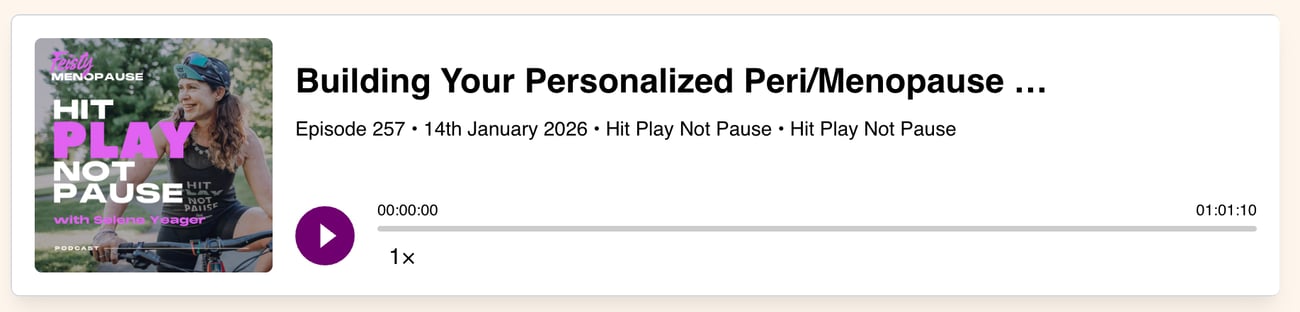
Listen to this week's episode of Hit Play Not Pause - Building Your Personalized Peri/Menopause Plan
|
 |
|
|
|
|
|
|
|
Feisty 40+ is written by Selene Yeager. Edited by Maya Smith. Ads by Ella Hnatyshyn
Live Feisty Media Corporation, 2031 Store St #30, Victoria, British Columbia V8T 5L9, Canada
Update your email preferences or Unsubscribe |
|
|
|
|