Share
Not what you think.
 ‌ ‌ ‌ ‌ ‌ ‌ ‌ ‌ ‌ ‌ ‌ ‌ ‌ ‌ ‌ ‌ ‌ ‌ ‌ ‌ ‌ ‌ ‌ ‌ ‌ ‌ ‌ ‌ ‌ ‌ ‌ ‌ ‌ ‌ ‌ ‌ ‌ ‌ ‌ ‌ ‌ ‌ ‌ ‌ ‌ ‌ ‌ ‌ ‌ ‌ ‌ ‌ ‌ ‌ ‌ ‌ ‌ ‌ ‌ ‌ ‌ ‌ ‌ ‌ ‌ ‌ ‌ ‌ ‌ ‌ ‌ ‌ ‌ ‌ ‌ ‌ ‌ ‌ ‌ ‌ ‌ ‌ ‌ ‌ ‌ ‌ ‌ ‌ ‌ ‌ ‌ ‌ ‌ ‌ ‌ ‌ ‌ ‌ ‌ ‌ ‌ ‌ ‌ ‌ ‌ ‌ ‌ ‌ ‌ ‌ ‌ ‌ ‌ ‌ ‌ ‌ ‌ ‌ ‌ ‌ ‌ ‌ ‌ ‌ ‌ ‌

View this email in a web browser

Subscribe to Triathlonish


issue #168: Jan. 15, 2026


All-sporters, what a start to the year it's been, right. 


I went right from back-to-work to Orlando, from conferencing to visit some family, and just got home yesterday. So, I already feel whirl-winded and it's only January 15th.


We recorded a podcast episode from Endurance Exchange, which will come out tomorrow on the Feisty triathlon feed, with a whole bunch more analysis and some quick takes and coaching tips from people there. But I'm going to try to make it all make sense in less words here today. At least, try.


- Kelly


P.S. You can find past Triathlonish issues and subscribe here now.


The 2026 State of the Sport report


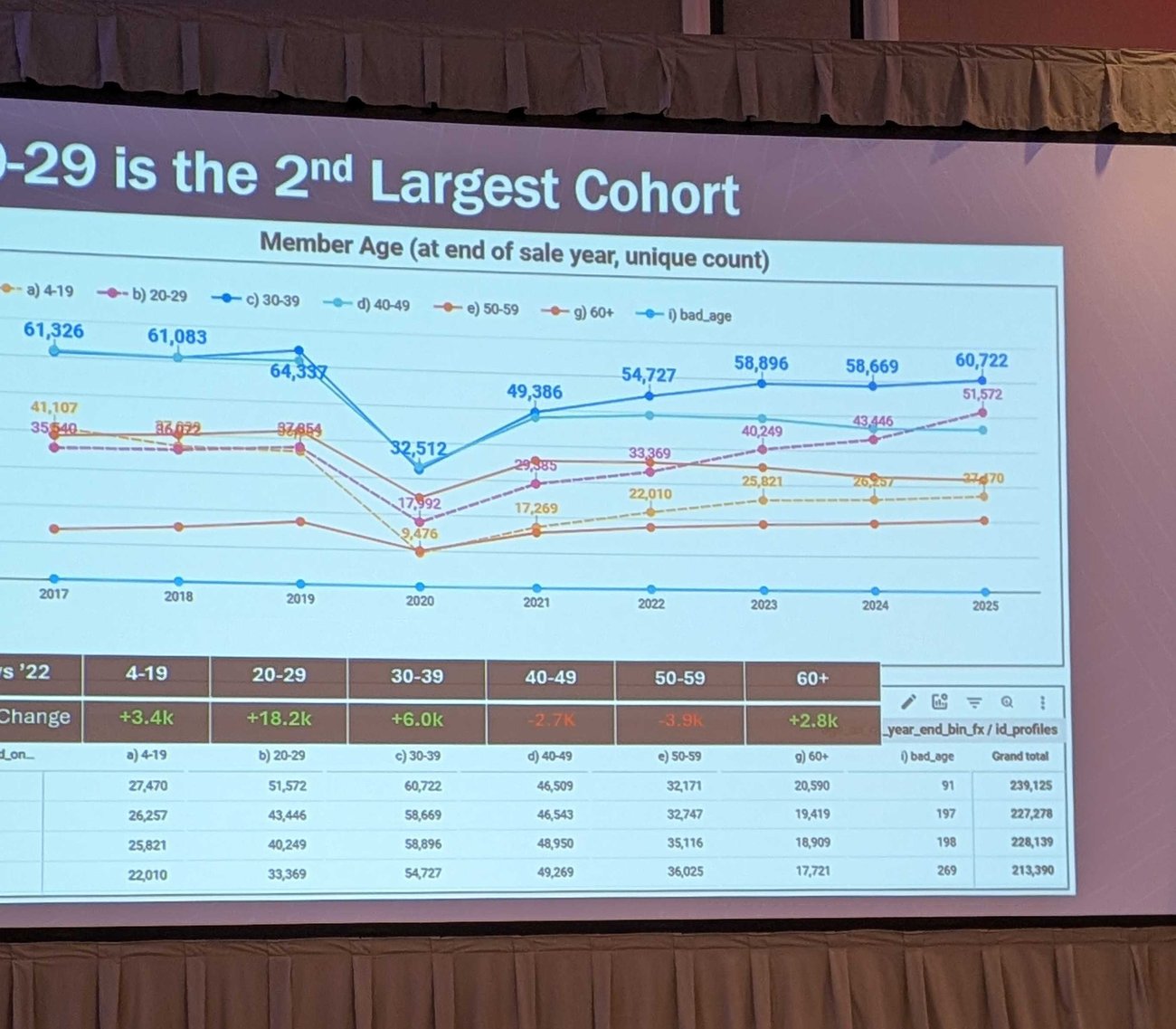
This graph, which came in the very last session on the very last day, was the most interesting chart from USA Triathlon's Endurance Exchange conference:

Photo: USAT


What it shows is that the 20-29 age-group (the pink line) is up consistently over the last three years. That age-group is now the second biggest age-group after the 30-39-year-olds. 


At the same time, it shows that the 40-49 age-group (the orange line) has been on the steady decline over that same time period. 


The sport is now made up predominantly of 20- to 39-year-olds. Not 40- to 59-year- olds. Even if it doesn't feel that way, lol.


A footnote: These numbers are from USAT's stats. USAT captures all sanctioned races in the U.S. Though the large majority of races are short-course and independent, their numbers include Ironman. So it is, in most ways, the most complete and accurate data of what's happening in the biggest market in triathlon. (No, it does not include non-sanctioned races, and some of those, like the Cal Tri race series, have definitely grown. But because USAT provides insurance for all sanctioned U.S. races and every athlete at a race has to then buy a one-day or annual USAT membership, their stats capture well over 95% of the races and triathletes in the country. And, certainly, provide a year-over-year picture.)


BUT. But! There is an important caveat to this youth-ing of triathlon. The youths have very different behavior patterns. 


According to the data, the majority of these 20-29 triathletes wouldn't consider themselves triathletes. The vast vast majority of these are one-day licenses; they do one, maybe two events, and they then (so far) move on to something else.


This corresponds with what we understand of this age-group. They want to do bucket list things, they want experiences. (There's some very basic Psych 101 at play here for a cohort that came of age in the era they came of age in.) They care about health and wellness and performance in a way that 20-29-year-olds have not historically, and broadly they do fitness. So jumping into this event or that event or why not makes sense to them. Hell, it makes sense to me.


The only reason this is either a problem or an opportunity for triathlon. The reason that Ironman is paying for influencers to do their events. Is because, at the same time, we're also seeing that what has been the historic core of triathlon, the people you could count on to do your events over and over and over, they aren't doing triathlon anymore. That 40-49 and 50-59 age-groups, they're the ones who made up that dedicated 'triathlete for life' base. They were always a small group — it's actually only 5% of the USAT membership that ever does 16+ races in their lifetime (so congrats to all of you who are reading this, you're probably already in the 5%) — but without them you lose the diehard evangelist core customer you can count on.


So. What do you do now? 


You either change or you don't. 


I spend a lot of time reading about and thinking about and talking to people about the K-shaped economy and vibecession, and about what's happening in the U.S. right now. And you can pretend those things don't have anything to do with triathlon, but you'll just be pretending yourself right out of business.


There were a lot more stats from the USAT report: the number of events has leveled off from last year at 829 v. 824, the number of members is at 303K (not quite pre-COVID's 329K), and the number of total race starts is down 3% from last year. And there was a bunch of data from the State of the Sport survey, too — which is, in essence, a consumer sentiment survey, but I have decided is only so-useful a survey because it doesn't track the same consumers year-over-year (ie. I bet race directors who went out of business feel less optimistic about their financial prospects, but we don't ask them do we).


And you can interpret those numbers probably however you want to interpret those numbers. "New triathletes feel the number of triathlons in their area is increasing!" (OK!) But underlying every conversation I had and every one of these stats is the overwhelming sense of uncertainty. 


(And no one means good uncertainty. They're not like 'gee I just am not sure how amazing things are going to be.')


Why aren't people registering for races early anymore? Because they don't know what the hell is going to happen between now and June! It makes sense to wait, makes sense to me. Why are race directors struggling to plan their budgets? Because they don't know how much their costs are going to go up! And they don't know how much their customers can absorb price increase to cover those costs. Why are people declining spots and trying other things and holding onto their money and training but waiting? Because wtf is the world even!


Over and over, what I am hearing is that it is this uncertainty that is going to define the business of our sport for the next few years. At every level. Not because there is something uniquely wrong with triathlon, but because we are not unique and we are not immune.


So what do you do? You either change or you don't.


From the races


Results: Pucon 70.3


Mark your calendars: I did make a Big Calendar of Important 2026 Pro Races (with all the details on how to watch each of the different brands' events) — but part of the reason it took me so long is because I was still sorta waiting to hear about Challenge and Supertri. My understanding right now is that Supertri will simply be adding a pro/elite wave to the front of its mass participation events, but no calendar or details have been put out (as best I know), so it feels a little bit as if any calendars with those listed are just making it up? But maybe they all know something I don't. Like dates.


The -ish


Some of the things worth knowing about this week in our sports — or that I just think are interesting.

  • The PTO did announce a new world rankings system for 2026 — going to four races (instead of three), any mix of distances, and getting rid of the 5% bonus on your best score. My first impression is this has the effect of continuing to make the T100 worth more, because they're already worth more and without the 5% bonus the top other races won't reach those point levels. This matters more because rankings will be more important in getting T100 starts this year. It matters less because there's not $2 million in rankings payments anymore, so. (PTO)

  • Ironman announced a new Malaga 70.3 race in Spain this October. And I will say when I was putting together the Big Calendar of 2026 Races it becomes clear that some locations are attracting a bunch of events, which one has to assume is related to money. (Ironman/Feisty)

  • Ironman also hosted a 5150 (which yes, still exists, sorta) in India this past weekend, but had to cancel the swim. (MSN)

  • The Lievin Indoor Triathlon was postponed indefinitely. (World Triathlon)

  • Supertri is launching a first-timers program, with 12 weeks of free TriDot coaching to first-timers who sign up. (Supertri)

  • They're calling it the first indoor triathlon training center in N. America — opening in Edmonton this month — which is primarily because of the velodrome, otherwise it's just a big indoor gym. (Curiocity)

  • We recorded a Feisty Tri episode with Rosie Wild last week. And even with my wild mic issues lately (I think I fried my mic and it is broken), it was one of my favorite episodes. (Feisty Tri)

  • Jan has a podcast now, with Alistair as the first guest. (Going Mental)

  • Grayson Murphy wrote about pro runners v. influencers (though substitute pro triathlete for runner and same-same) and how they're very different jobs. And part of me is like 'yeah sure, one job is paid to run and one is paid to post about running.' But part of me like 'no, sorry, they're both jobs where you're being paid to entertain people and influence them to buy stuff via running and posting about running.' You can do either part of that job more than the other part (running v. videos of running); your choice. (Racing Grayson)

  • I think trail running is going through a lot of the same things triathlon went through. If only they had some other sport to learn from. (Trailmix)

  • Molly Siedel is officially trail running now, with a course record and overall (ie. beat the men) win at the Bandera 50K. Next up is the Western States qualifying Black Canyon 100K — which I am sure the trail running universe is going nuts about. (Runner's World)

  • Tallahassee hosted the XC World Champs, with wood alligator-shaped obstacles, and the 4x2km mixed relay looks fun. (CitiusMag)

  • Strava apparently filed for a confidential IPO. (The Information)

  • I did not think the L.A. Olympic ticket registration was that confusing. (Register during this time period right now, and you're assigned a window when you can buy tickets in April.) But then I had to listen to all these news stories about how people couldn't get in or figure it out. And, like, why were you waiting 60 minutes in the first place in a virtual waiting room to register? The lottery registration period is open until March; this isn't a 'you have to be first in line' situation. (The Athletic/New York Post)

  • What if success is more luck than you want to admit? (The Atlantic)


One last thing


It's not not accurate.


SUBSCRIBE & PAST ISSUES
Subscribe

Triathlonish is written by Kelly O'Mara. Ads by Ella Hnatyshyn


Live Feisty Media Corporation, 2031 Store St #30, Victoria, British Columbia V8T 5L9, Canada


Update your email preferences or unsubscribe